Polyurea Coatings: Chemistry, Concrete Bonding, and Nano-Enhanced Durability
Polyurea coatings have become a top choice in Portland, Oregon, for industrial and residential concrete applications due to their rapid curing times, exceptional durability, and strong adhesion to concrete surfaces. At Nano Concrete Coatings, we specialize in applying polyurea to protect and enhance concrete structures, ensuring long-lasting performance.
Understanding Polyurea Chemistry
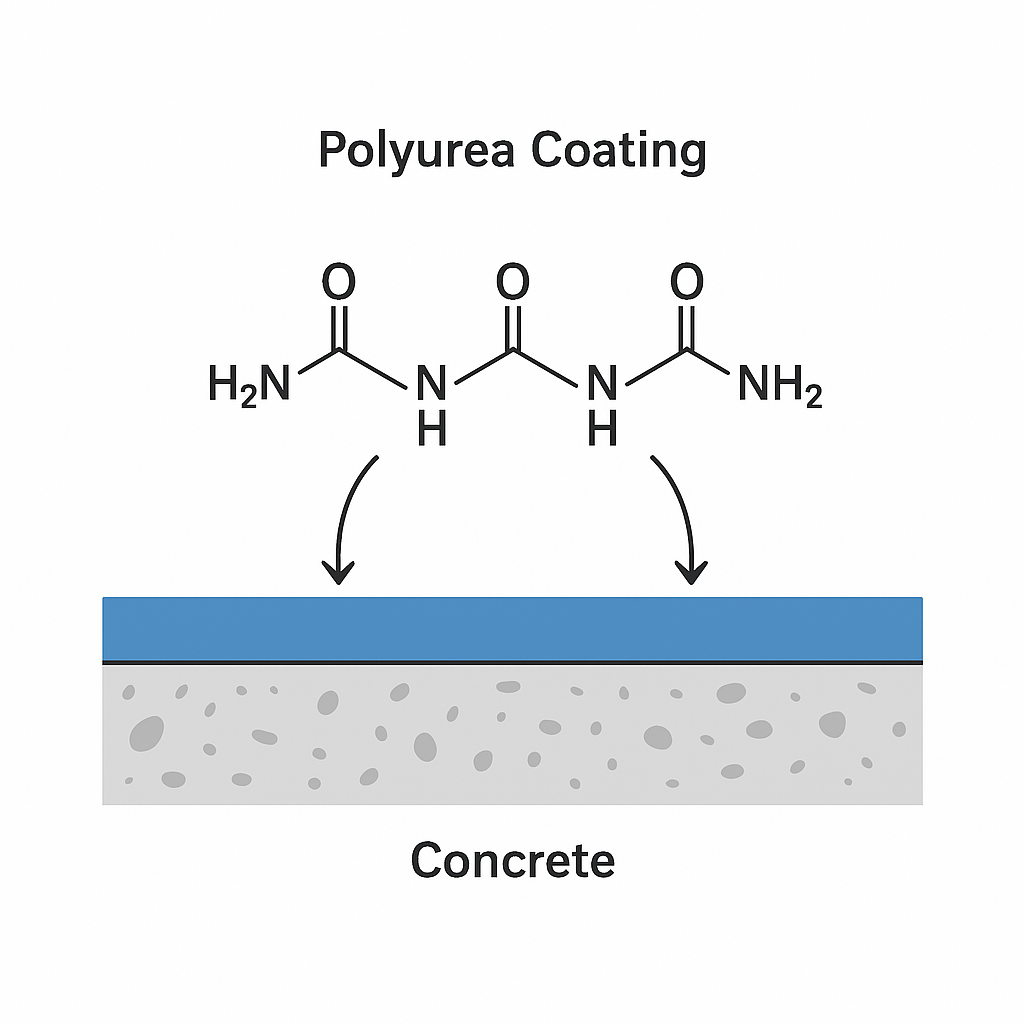
Polyurea is a synthetic polymer formed from the reaction of a polyamine with an isocyanate, resulting in urea linkages (-NH-CO-NH-). This step-growth polymerization creates a network of hard and soft segments that give polyurea both flexibility and strength.
Chemical Structure
The general chemical reaction can be represented as:
Polyamine + Isocyanate → Polyurea (with urea linkages)
These urea linkages are responsible for polyurea’s rapid curing, high tensile strength, and resistance to moisture and environmental degradation.
Recent studies, including one published in Polymers (MDPI, 2023), have analyzed the molecular structure of polyurea coatings and confirmed their superior adhesion properties on concrete substrates under varying humidity and temperature conditions.
Bonding Mechanism to Concrete
Polyurea adheres to concrete through both chemical and mechanical mechanisms. When applied, it penetrates the concrete’s porous surface, reacting with moisture to form urea linkages, creating a strong, durable bond.
Factors Affecting Bond Strength
Surface Preparation: Abrading and cleaning the concrete surface enhances adhesion.
Moisture Content: Slightly damp concrete can improve the chemical bond.
Curing Conditions: Temperature and humidity affect final bond performance.
A 2022 study in Construction and Building Materials demonstrated that polyurea coatings improve interfacial fracture energy and bond strength compared to traditional epoxy coatings, particularly on lightly prepared concrete surfaces.
Nano-Enhanced Polyurea: Advancements in Durability
Incorporating nanomaterials like silica nanoparticles, graphene oxide, or carbon nanotubes into polyurea has been shown to improve mechanical strength, thermal stability, and chemical resistance. These advancements are especially useful for industrial floors and exterior concrete exposed to harsh conditions.
A 2021 Journal of Materials Science article reported that carbon nanotube-reinforced polyurea increased impact resistance and tensile strength by over 20% compared to standard formulations, making it an excellent choice for heavy-use concrete surfaces.
Applications in Concrete Protection
Polyurea coatings from Nano Concrete Coatings in Portland, Oregon, are ideal for a variety of applications:
- Industrial and Commercial Flooring: Durable and resistant to abrasion and chemical spills.
- Waterproofing: Prevents water ingress and protects structural integrity.
- Blast and Impact Resistance: Reinforces concrete against high-impact forces.
By using polyurea coatings, structures are safeguarded against environmental and mechanical stresses, significantly extending their lifespan.
Visualizing the Bonding Process
On a microscopic level, polyurea penetrates the pores of the concrete surface, reacts with moisture, and forms urea linkages that create a resilient chemical and mechanical bond. Visualizing this structure helps in understanding why polyurea is so effective as a concrete protective coating.
Note: Molecular diagrams can be generated with chemistry visualization software for further illustration.
Conclusion
For homeowners and businesses in Portland, Oregon, Nano Concrete Coatings offers expert polyurea coating solutions that combine advanced polymer chemistry with practical durability. The chemical robustness, strong adhesion, and nano-enhanced reinforcement of our polyurea applications ensure that your concrete surfaces will withstand wear, environmental stress, and chemical exposure for years to come. Choosing Nano Concrete Coatings means investing in quality, longevity, and cutting-edge polyurea technology.
References
- Ultimate Linings. (n.d.). Polyurea Chemistry. Retrieved from https://ultimatelinings.com/polyurea-science/polyurea-chemistry/
- Motor City Floors and Coatings. (2023, July 21). The Remarkable Bond Strength of Polyurea Concrete Coatings. Retrieved from https://motorcityfloorsandcoatings.com/the-remarkable-bond-strength-of-polyurea-concrete-coatings/
- MDPI. (2023). Influence of Polyurea Coatings on Low-Longitudinal-Reinforcement Concrete Beams. Retrieved from https://pmc.ncbi.nlm.nih.gov/articles/PMC9000338/
- MDPI. (2023). Recent Developments in Polyurea Research for Enhanced Impact Protection. Retrieved from https://pmc.ncbi.nlm.nih.gov/articles/PMC10856947/
- ScienceDirect. (2023). Impact Behaviour of Concrete Specimens Coated with Polyurea. Retrieved from https://www.sciencedirect.com/science/article/abs/pii/S235201242500075X
- MDPI. (2021). Nano-Reinforced Polyurea for Improved Mechanical Properties. Retrieved from https://www.mdpi.com/2073-4360/16/4/454